 |
 |
Updated 2000-11-08 Swedish version |
|
|
Updated 2000-11-08 Swedish version |
| A month in Yukon Two years in a row Photographs by Hans van Klinken
 Lake trout
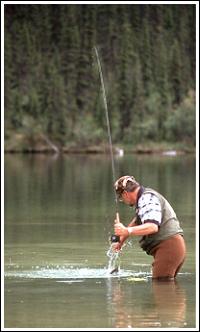
have unique ways of fighting. Frequently, when initially hooked, they provide only token
resistance until they see you or the boat. Then all politeness goes out the window and a
real fight begins. Although they rarely become airborne, lake trout do make very strong
runs and demonstrate commendable strength. More than once they broke a brand new 5 lbs
tippet. Once they are brought closer to the boat or float tube, lakers change tactics.
Frequently they begin indescribable gyrations around a fixed point somewhere within their
heads. As a result they either wind themselves up completely with coils from the leader,
or they pull the fly out of their mouth and get away. I have seen lakers pull treble hooks
out of their mouths using this method. Another method, implemented by the trout when
brought toward shore, is to dive nose first into weeds or sand and thus rub the fly out of
their mouth.
Although I prefer fly fishing and consider other methods of fishing to be
less sporting and less fun, we nevertheless did try trolling and casting for fish. A depth
indicator frequently found very large lakers 20 or more meters below the surface far too
deep for effective fly fishing. Lake trout have a similar preference to that of Pacific
Salmon. They grab best when the spoon is twisting wildly. I once dragged an excellent
Rebel lure replica of a small fish for two hours up and down the lake without so much as a
bite. I switched sizes and colors and continued trolling Rebel lures. Still nothing
happened. But as soon as I changed to an enormous Crocodile Spoon, which makes exaggerated
twists and spins, and commenced trolling along the same section of the lake, trout
immediately grabbed the lure. I have no idea what the trout take these lures to be they
certainly don ’t look like anything edible that I can recognize.
Lake trout
have unique ways of fighting. Frequently, when initially hooked, they provide only token
resistance until they see you or the boat. Then all politeness goes out the window and a
real fight begins. Although they rarely become airborne, lake trout do make very strong
runs and demonstrate commendable strength. More than once they broke a brand new 5 lbs
tippet. Once they are brought closer to the boat or float tube, lakers change tactics.
Frequently they begin indescribable gyrations around a fixed point somewhere within their
heads. As a result they either wind themselves up completely with coils from the leader,
or they pull the fly out of their mouth and get away. I have seen lakers pull treble hooks
out of their mouths using this method. Another method, implemented by the trout when
brought toward shore, is to dive nose first into weeds or sand and thus rub the fly out of
their mouth.
Although I prefer fly fishing and consider other methods of fishing to be
less sporting and less fun, we nevertheless did try trolling and casting for fish. A depth
indicator frequently found very large lakers 20 or more meters below the surface far too
deep for effective fly fishing. Lake trout have a similar preference to that of Pacific
Salmon. They grab best when the spoon is twisting wildly. I once dragged an excellent
Rebel lure replica of a small fish for two hours up and down the lake without so much as a
bite. I switched sizes and colors and continued trolling Rebel lures. Still nothing
happened. But as soon as I changed to an enormous Crocodile Spoon, which makes exaggerated
twists and spins, and commenced trolling along the same section of the lake, trout
immediately grabbed the lure. I have no idea what the trout take these lures to be they
certainly don ’t look like anything edible that I can recognize.
Ernie Nagy believes that these shiny, twisting lures somehow make the trout angry. They follow them from behind, snapping at their tails which, of course, are not tales, but large barbless hooks. One method used during trolling, which Ernie taught me, was to raise the rod and thus pull the lure in, and then to drop the rod tip, thus forcing the lure to fall back. Frequently it falls back right into the face of a following trout, which automatically grabs it and gets hooked. Closer to shore, to my surprise, large plastic worms with wiggly tails also attracted trout. However, the trout would bite the tail off and not get caught until I began attaching cheater hooks. That solved the problem. Although because of the white nights, there was no visible difference in the amount of light day or night; I found that larger trout would bite more between 5:00 and 7:00 a. m. than at any other time.
Living in the wilderness and at times experiencing rather cold evenings and nights, we learned that fish heads, tails, and fins are great for fish soup, which, in turn, is a very pleasant way in which to warm up on a cold evening. We also learned that anointing the fish inside and out with vegetable oil (preferably olive oil), sprinkling it with liberal amounts of lemon pepper, wrapping it in aluminum foil, and dropping it into hot coals after a campfire provides a delicious, warm finger food with easily detachable bones. Since we spent four weeks in the wilderness, fishing was by far not our only pass time. The day would frequently start with myself getting up sometime around 5:00 in the morning, putting on the coffee pot, and going out fishing or rowing for an hour or two. This was the time that I saw the most animals. One animal, which became a regular friend, was the bald eagle. Early one morning, soon after we arrived at Dogpack Lake, I released a grayling. Tired from the fight, it rested on the surface, rather than immediately heading for deeper water. That was it’s undoing, the eagle swooped down and picked it up. After that the eagle would wait every morning, looking for a hand out. If I did not show up by 6:00 a.m., the eagle would fly to a tree close to our tents and sometimes even call for breakfast. Fish carelessly left near the camp sight before being cleaned, where also taken by the eagle. Usually everybody was still asleep when I returned and had a second cup of coffee. After breakfast our activities would begin. We climbed some of the surrounding mountains and frequently went walking along well-used moose trails; numerous times we hiked to a small lake, which had an equally small island. Since this lake has no name on the map, so we named it "Island Lake ". In order to get to this lake it was necessary to take off our boots and ford an ice-cold, small, almost waist deep river with a rather strong current. There are no fish in Island Lake it is too shallow for fish, being no more than 1 1/2 meters deep at its lowest point. Thus, in the sever Yukon winters this whole lake turns into a solid piece of ice and any fish would be killed. However, we saw more wildlife on Island Lake than anywhere else. Mostly moose come to feed at its shores, but tracks indicated that the wolf, the bear, the fox, and the badger also visit this lake. One fun activity is to make Plaster of Paris casts of various animal and bird tracks. Back at home they are cleaned up, put into frames, and hung in the family room along with other choice photographs as a constant reminder of the wilderness.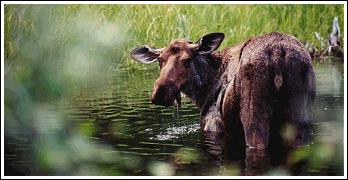
During one of our visits my wife and youngest daughter decided to explore the shores of Island Lake. This is a leisurely 30-minute walk along the shore of this small body of water. When they returned to where they had started and noticed their own footsteps in the moist ground they could hardly believe what they were seeing a wolf had calmly followed my daughter, obviously deliberately putting his paws directly into tracks left by her boots. Canadian Gray Wolves are the stealthiest of all animals and are extremely difficult to see unless they choose to be seen. We never saw him, although he was walking behind my daughter and wife! There are also many shore birds and ducks, which frequent the lake. One shore bird would never fails to raise a loud alarm call as soon as any large animal approached. It would scream at us also, as we approached and then crossed over to the island. But as soon as we settled down on the island, the bird would cease its alarm call. Once, while my girls were quietly drawing on the island and I was reading, the bird began to call in alarm again. We looked up and saw a gorgeous lynx walking out from the forest. Because we wear olive drab clothing in the forest, and because the wind was coming toward us, the lynx was not aware of our presence. Carefully it smelled the air and observed the lake. Then slowly and majestically it walked out to the lake ’s edge, took a long drink, and lay down on the warm sand. After a while it got up and calmly walked up a hill, finally disappearing into the forest. We felt awed and privileged to have seen this rare and stealthy animal. This was only the second time that we had seen lynx.
 My wife is a professional artist and both my
daughters love to draw. Thus, they spent much time drawing from nature as well as creating
very amusing cartoons of some of the daily life in the wilderness. When they made their
daily entries into their diaries, they frequently peppered them with cartoons and
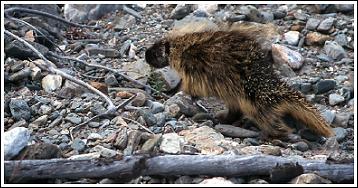
caricatures Almost every night we had a visitor the porcupine. It would crawl under the
wooden floor of the tent cabin and begin noisily gnawing on the plywood. This would
continue for hours. Sometimes two or three would come and create a ruckus, fighting and
arguing for hours. We tried to think of a way to chase the porcupines away without hurting
them. I tried bribing him with carrots, but he would only smell the carrot, click his
sharp incisors, and insulted me by trying to urinate on me! Finally we all agreed that we
had had enough; I came outside, leaned under the tent cabin, and sprayed him with bear
spray. The porcupine left, but the pepper spray somehow came up through the cracks in the
floor and choked us the whole nightlong. For about four days we had peace and quiet at
night, but then the porcupine came back. We admitted defeat and left him alone.
However, after
the big storm we pulled some of the fallen trees up along side the tent and prevented the
porcupine from crawling under our tent. The porcupine then started chewing on the other
tent floor, but that did not bother us as much. It rains frequently in the Yukon. Once it
rained for four days and four nights without stopping. On such rainy days we relaxed by
playing cards, drawing, or reading. We all brought books of both a classical and a
spiritual nature, and almost every day we would dedicate at least an hour to reading. The
idea was to use this wonderful wilderness to feed the intellect as well as the soul. When
it rained, we would read that much more. I also used the rainy periods as an opportunity
to hone my weak fly tying skills, teaching myself how to tie various fly patters, and to
refill my fly box. Frank Amato’s book Flies of the Northwest proved to be an
excellent manual. It also gave me an opportunity to experiment with new materials and
create new variations of old flies, based on what I was learning in the Yukon.
My wife is a professional artist and both my
daughters love to draw. Thus, they spent much time drawing from nature as well as creating
very amusing cartoons of some of the daily life in the wilderness. When they made their
daily entries into their diaries, they frequently peppered them with cartoons and
caricatures Almost every night we had a visitor the porcupine. It would crawl under the
wooden floor of the tent cabin and begin noisily gnawing on the plywood. This would
continue for hours. Sometimes two or three would come and create a ruckus, fighting and
arguing for hours. We tried to think of a way to chase the porcupines away without hurting
them. I tried bribing him with carrots, but he would only smell the carrot, click his
sharp incisors, and insulted me by trying to urinate on me! Finally we all agreed that we
had had enough; I came outside, leaned under the tent cabin, and sprayed him with bear
spray. The porcupine left, but the pepper spray somehow came up through the cracks in the
floor and choked us the whole nightlong. For about four days we had peace and quiet at
night, but then the porcupine came back. We admitted defeat and left him alone.
However, after
the big storm we pulled some of the fallen trees up along side the tent and prevented the
porcupine from crawling under our tent. The porcupine then started chewing on the other
tent floor, but that did not bother us as much. It rains frequently in the Yukon. Once it
rained for four days and four nights without stopping. On such rainy days we relaxed by
playing cards, drawing, or reading. We all brought books of both a classical and a
spiritual nature, and almost every day we would dedicate at least an hour to reading. The
idea was to use this wonderful wilderness to feed the intellect as well as the soul. When
it rained, we would read that much more. I also used the rainy periods as an opportunity
to hone my weak fly tying skills, teaching myself how to tie various fly patters, and to
refill my fly box. Frank Amato’s book Flies of the Northwest proved to be an
excellent manual. It also gave me an opportunity to experiment with new materials and
create new variations of old flies, based on what I was learning in the Yukon.
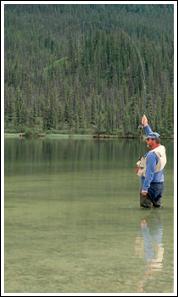
Returning to Tincup and Dogpack Lakes this year was coming home for us. This time we traveled lighter, bringing less food and eliminating unnecessary clothes and other equipment. My wife bought two new camera lenses and took many roles of pictures. We initially spent some time at Tincup Lake, where one of the guides, Ron Chambers, and I went looking for pike. It turned out to be too late for their breeding season, but we found some large trout and landed a number of lakers in the 15-20 pound class. We learned something interesting: contrary to popular opinion, lake trout do feed off the surface! The fish that were feeding in the middle of the lake were not grayling, but lakers! This was something totally new for me. The larger fish continued to hug the bottom. Again, the fly of Dogpack 20 choice was the Woolly Bugger with a few variations. I had added a few Flashabou strings to the marabou tail. With the perpetual darkness of the deep these strands of Flashabou are supposed to catch and reflect what little light there may be at such depths. Also I heavily weighted the fly, and tied on bead chain eyes not only for the purpose of sinking the fly quicker and deeper, but also because this seemed to make the fly more attractive. The Tincup Woolly, as we named this fly, calls for an extra long hook shank the longer the better so that the marabou can be tied half way up the hook. The hook curve and the marabou tail ends are about equal with each other. This method prevents short strikes a frequent problem when fishing for lakers in deeper water. Ron and I noticed that this fly was very attractive to the large lake trout. Over and over again it would get strikes and fish when other flies and lures failed. We both watched as time and again trout would come dashing out of the deep or the cover to carelessly inhale the fly. I observed as a 15+ lbs trout made a bee-line run of about 15 yards just to take the Tincup Woolly. Each time they would completely inhale the fly, turn and head back to where they came from; there were no hesitations. One fish was so large that it took out almost all of my 200 meter backing in its initial run, before going into gyrations and spitting out the fly. Thanks to Ron I had one of the greatest fishing days of my life. There are huge fish in that lake!  This year
there were some changes at Dogpack Lake. The grayling were no longer as eager to feed from
the surface. But the trout were much more abundant and more willing to take flies. It was
fun trying to land a large laker on a size 18 fly with a 7 X tippet. Some trout were so
much darker; they almost appeared to be a different species. It had been an unusually wet
spring and the mosquitoes were thicker than ever. This, of course, provided for better
fishing the stomach contents of both the grayling and the trout was filled mainly with
mosquito and midge larva, as well as small snails. This in turn clearly indicating which
fly to tie up and cast in. The TDC and the YDC, along with a black AP nymph became
favorite patters. This year I took a 3 weight, four-piece backpacker ’s Elk Horn rod
for the grayling, and was extremely pleased with this equipment. It provided for a much
sportier play and was much easier to cast.
This year
there were some changes at Dogpack Lake. The grayling were no longer as eager to feed from
the surface. But the trout were much more abundant and more willing to take flies. It was
fun trying to land a large laker on a size 18 fly with a 7 X tippet. Some trout were so
much darker; they almost appeared to be a different species. It had been an unusually wet
spring and the mosquitoes were thicker than ever. This, of course, provided for better
fishing the stomach contents of both the grayling and the trout was filled mainly with
mosquito and midge larva, as well as small snails. This in turn clearly indicating which
fly to tie up and cast in. The TDC and the YDC, along with a black AP nymph became
favorite patters. This year I took a 3 weight, four-piece backpacker ’s Elk Horn rod
for the grayling, and was extremely pleased with this equipment. It provided for a much
sportier play and was much easier to cast.
One of the eagles was a bit wearier of us this year, but the larger female seemed to remember us and took many of our fish. Two juvenile eagles also appeared at both Lakes. The bear came to watch us land and also to check out our boats for leftover fish. Bear tracks came right up to our campsite, but again, we had no trouble with them. We saw more moose with calves this year and there were more mountain sheep to be seen with the optics. One night a moose grazed right in the middle of our campsite. A wolf was sighted at Tincup Lake, but the wolves did not howl for us. We did not see any lynx this year, but a moose came so close to us at Island Lake, that a few feet more and we could have touched it. The weather was quite a bit cooler and wetter, twice we had hail and once we even thought we had a bit of snow all this in July! Wading rivers in freezing weather was quite an experience. A number of times Larry flew in guests to Dogpack Lake and left them with us for the day. One such party of guests was Hans van Klinken and his delightful wife Ina. Introducing Hans, Larry said that he was one of the officers of the European Grayling Society and was hoping to catch some grayling and whitefish. I greeted him with the words "Welcome to Paradise ". And a grayling fisherman ’s Paradise it was. Hans later said that never before had Dogpack 22 large grayling attacked his streamers. But the whitefish proved illusive and difficult to catch. Hans is an innovative fly tier and his unique, immaculately neat patterns worked better than anything I had. He was kind enough to give me a set of his flies; but I have no intention of using them. They should be framed and hanging in a museum of art. Almost everything Hans uses for fishing and fly tying he made himself. Even his whip finisher and his bobbin are the work of his hands. A true professional fisherman, Hans enjoys spreading the fly fishing gospel and watching people excel at this exciting, yet peaceful, rhythmic sport.
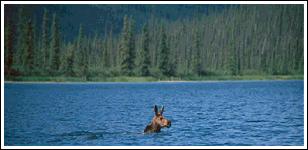
Ina van Klinken is not only an accomplished fly fisherwoman herself, but also is the main photographer. While we were getting ready to fish, a bear chased a young moose into the lake about 200 meters away. As the moose swam to the other shore, Ina and I jumped into the boat and caught up with the animal. Trying not to scare the animal too much we circled around the moose and Ina took many pictures. Because she is able to combine an active love for the outdoors with gentleness and femininity, my whole family quickly came to consider Ina one of our favorite people. One day Larry flew in and took my wife and me pike fishing in Brooks Arm. We caught many pike, mostly on flies. My wife caught the largest, approximately a 10 pounder. Pike fillets, when carved out correctly, have no bones and are delicious to eat. For two days we ate pike and could not get enough of this delicacy. About a week later Larry and Jose took some time off from the lodge and also went fishing for pike at Brooks Arm. Jose caught a huge pike that must have been well over 35 pounds. This fish is slated to be mounted and placed on the wall of the main Tincup Lake Lodge building. Some lake trout over 30 lbs were caught this year immediately outside the lodge, where a small river runs into the lake. During the last week of our stay our two daughters moved to Tincup Lake Lodge and worked there under Jose ’s supervision. Jose is an accomplished gourmet artist in her own right, featured in West European cuisine magazines. The girls learned much from Jose and developed a new, more mature appreciation for the task of running a lodge successfully. After my wife and I left, our daughters stayed another 10 days, helping out at the lodge, before flying back to California. They had never met anyone with so much laughter, enthusiasm, and professional skills. Larry’s idea of opening up the lodge for winter sports recreation, such as ice fishing, cross country skiing, or dog sledding wets our appetite. There is endless potential here. With his love for the outdoors and his knowhow, the sky is the limit in what will be done at this location, all the while leaving it as pristine, wild, and isolated as it is today. We all wish we could have stay longer.Much longer. Forever.
Back to page 1
All text by Padre |
||||||||

|
||||||||